Alzadasaurus tropicus
PALEOFAUNA OF VENEZUELA. The #nessie of Alta Gracia from Orituco. More information: @jp.sitev
https://www.instagram.com/eldinogerardo/
https://www.instagram.com/jp.sitev/
https://www.facebook.com/gerardoramon.guillenpoleo
Clarifications: The following official information about the present species dates from the publication made by Edward H. Colbert in 1949 about the discovery of partial remains of an Elasmosaurid #plesiosaur, made by Geologist Jorge Pardo in collaboration with H.D Hedberg (both of the former Mene Grande oil company). Investigations may be subject to change. Given the background and age of the case.
Although not much publicity is usually made on the subject, Venezuela also has relevant contributions on the subject of marine "reptiles" (correct name Sauropsids). One of these cases being that of the peculiar "Alzadasaurus tropicus".
A type of Plesiosaur, possibly related to famous long-necked Elasmosaurs similar to Styxosaurus and Callawayasaurus and whose exact naming and classification even today, more than 5 decades after its discovery, is not entirely clear. Discovered in the Alta Gracia region of Orituco, in the Querecual formation, Guárico state, its partial remains (see image 2 @jpsitev), were sent to the American Museum of Natural History in New York. Their current situation and status is unknown.
Although they are only estimates, it is possible that in life the animal measured between 8 and 10 meters long and fed on small schools of fish and mollusks, in part of the Andean Geosyncline basin, during the Cretaceous period of the current Venezuelan Territory.
Original research: Edward H. Colbert, Jorge Pardo. Paper 1949.
Illustration and writing by Gerardo Guillen Poleo @eldinogerardo
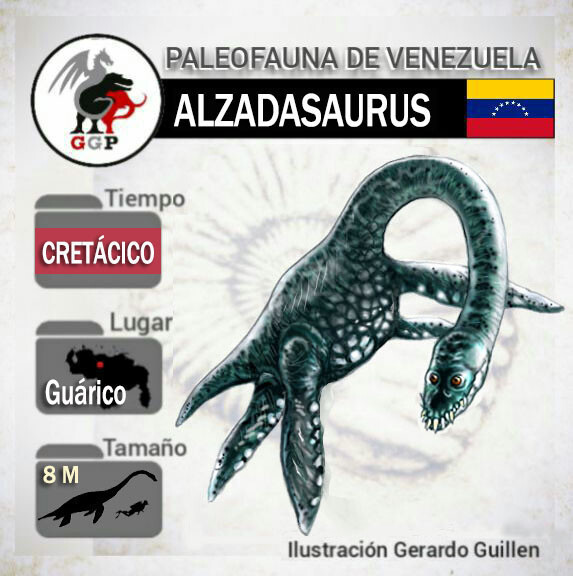
"Alzadasaurus tropicus" - Elasmosaurid today indeterminate.

Original fossil material of the enigmatic Venezuelan elamosaur.